

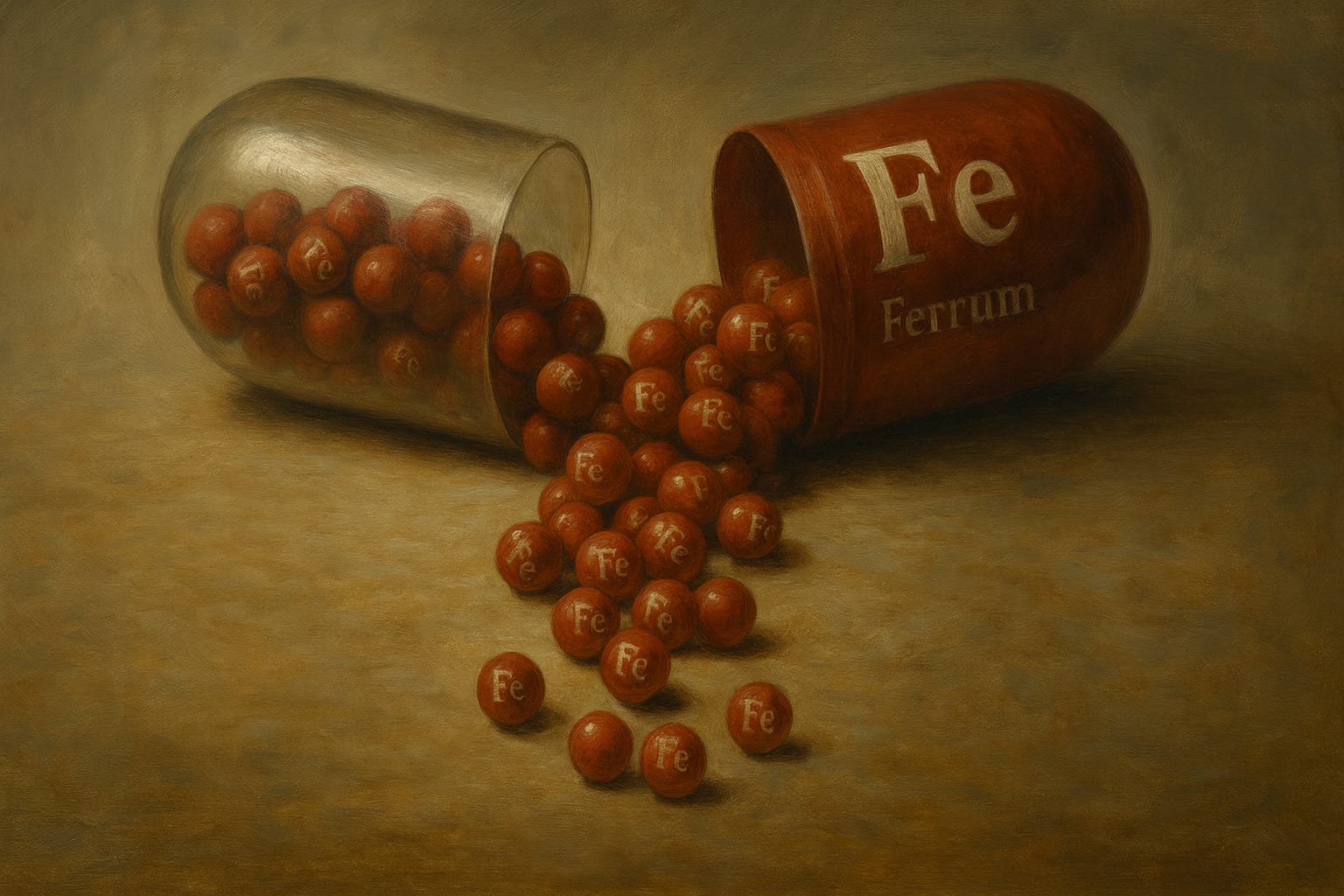
The Iron Overload Epidemic
And how iron deficiency anemia is a myth...

Struggling with low energy? I created a free guide that contains five simple, no-cost steps to improve your health in just 72 hours.
Click here and download a free “72-Hour Health Reset: 5 Free Steps” guide.
A lot of people wake up exhausted.
They drag themselves to the doctor, who orders blood work and delivers the verdict: iron deficiency anemia.
The prescription? Iron supplements.
Maybe even an iron infusion if it’s severe enough.
They follow the advice.
They take iron daily, and they choose iron-fortified cereals and foods.
And yet... nothing really changes.
Sure, maybe there is a temporary boost, but within weeks or months, they are right back where they started.
Tired, pale, and frustrated.
Here’s what most people don’t know: the solution you’ve been sold isn’t solving the problem.
In fact, it makes things worse.
Iron deficiency anemia affects millions worldwide, and the medical establishment has convinced us it’s a simple equation: low iron equals add more iron.
But if that were true, why are anemia rates still climbing despite our iron-fortified food supply and widespread supplementation?
Something doesn’t add up, and the answer lies in understanding what’s really happening inside your body.
“Low Iron” Isn’t What It Seems
Iron deficiency anemia is typically diagnosed through blood tests that measure serum iron or ferritin levels, basically, how much iron is floating around in your bloodstream.
When those numbers come back low, the diagnosis seems straightforward: you need more iron.
But here’s the critical flaw in this logic: blood tests only show part of the picture.
Your body contains approximately 5,500 mg of iron, but only a fraction circulates in your blood at any given time.
The vast majority is stored in your tissues and organs, your liver, spleen, heart, and even your brain.
These tissue stores can contain up to ten times more iron than what appears in your blood.
So when your blood test shows “low iron,” it doesn’t necessarily mean you’re deficient.
It might mean your body is hoarding iron in your tissues instead of making it available where it’s needed.
You can have too much iron in your body while simultaneously showing signs of iron deficiency in your blood.
The Root Cause Nobody Talks About
The real question isn’t “Do you have enough iron?”
Or rather, “Can your body actually use the iron it has?“
This distinction is everything.
And to understand why iron gets stuck, we need to look at what we’re doing to ourselves.
The Iron Overload Epidemic
Consider how much iron we’re exposed to compared to previous generations:
Fortified foods everywhere: Cereals, bread, pasta, flour, and countless packaged foods are fortified with iron
Widespread supplementation: Millions take daily iron supplements or multivitamins containing iron
Medical interventions: Iron infusions deliver massive doses directly into the bloodstream
Enhanced absorption: We’re told to take Vitamin C with iron to boost absorption, which compounds the problem
The result? We’re consuming at least ten times more iron than our ancestors did just a century ago.
Here’s what most people miss:
Iron is bioaccumulative.
Unlike water-soluble nutrients like Vitamin C, which your body can flush out when you have excess, iron builds up over time.
Your body has very limited mechanisms to eliminate it.
So every fortified bowl of cereal, every supplement, every infusion adds to a growing stockpile that has nowhere to go.
The Vitamin C Trap
You’ve probably heard that Vitamin C helps with iron absorption, and it does.
But when your body is already overloaded with iron, this “helpful” advice becomes fuel for the fire.
High Vitamin C helps your gut pull even more iron into your system, but that iron doesn’t go where you need it, it piles up in your tissues.
This creates a vicious cycle:
Blood test shows low iron
You take more iron supplements (often with Vitamin C)
More iron gets stored in tissues, not blood
Blood iron remains low
Anemia symptoms persist
Repeat
Iron Dysfunction, Not Deficiency
This brings us to the core truth: anemia isn’t about iron levels…
It’s about iron dysfunction.
Your body might have plenty of iron, but if it’s trapped in your organs and tissues instead of being mobilized into your bloodstream to make red blood cells, you’ll experience every symptom of anemia:
Crushing fatigue
Weakness and muscle exhaustion
Brain fog and poor concentration
Pale skin
Shortness of breath
Cold hands and feet
All while your tissues are quietly overloaded with the very mineral you’re told you’re lacking.
Why This Matters More Than You Think
Let’s talk about what happens when this iron dysfunction continues unchecked, because the stakes are higher than just feeling tired.
Iron infusions are often presented as a quick fix, a way to flood your system and get you back on your feet.
And yes, many people do feel better initially.
For a few weeks or months, energy returns, brain fog lifts, and life feels manageable again.
But here’s what your doctor probably isn’t telling you: those effects are temporary for most people, and the long-term consequences can be severe.
When you dump massive amounts of iron into an already overloaded system, that iron has to go somewhere.
It ends up stored in:
Your liver (leading to potential liver damage)
Your heart (increasing cardiovascular risks)
Your joints (causing pain and inflammation)
Your pancreas (affecting blood sugar regulation)
Your brain (potentially contributing to neurodegenerative conditions)
The Emotional Toll
Beyond the physical symptoms, there’s a profound psychological impact to living with chronic anemia that won’t resolve:
The frustration of doing everything “right” and still feeling terrible
The self-doubt when doctors can’t explain why treatments aren’t working
The loss of quality of life when you’re too exhausted to enjoy time with family or pursue your passions
The financial burden of endless supplements, doctor visits, and treatments that provide only temporary relief
The good news? Once you understand what’s really happening, the solution becomes clear, and it’s not what you’ve been told.
What You’ll Discover Below:
✓ The missing mineral that actually controls how your body uses iron (and why almost everyone is deficient in it)
✓ Why standard medical tests miss this deficiency and how tissue storage creates false readings
✓ The exact mechanism that keeps iron trapped in your organs instead of working in your blood
✓ How modern farming and food processing have created a hidden epidemic that’s driving anemia rates higher
✓ The surprising competition between minerals that makes iron supplementation counterproductive
✓ The superior solution that mobilizes your existing iron stores and addresses the root cause
✓ Why this approach outperforms iron treatments in clinical studies—often raising red blood cell counts above normal levels
✓ How to restore mineral balance without the dangerous side effects of iron overload
This isn’t another temporary fix. This is about understanding your body’s true needs and giving it what’s been missing all along.