

Eczema Is a Pathogenic Problem. Not a Skin Problem
What the medical establishment has been treating wrong for decades...

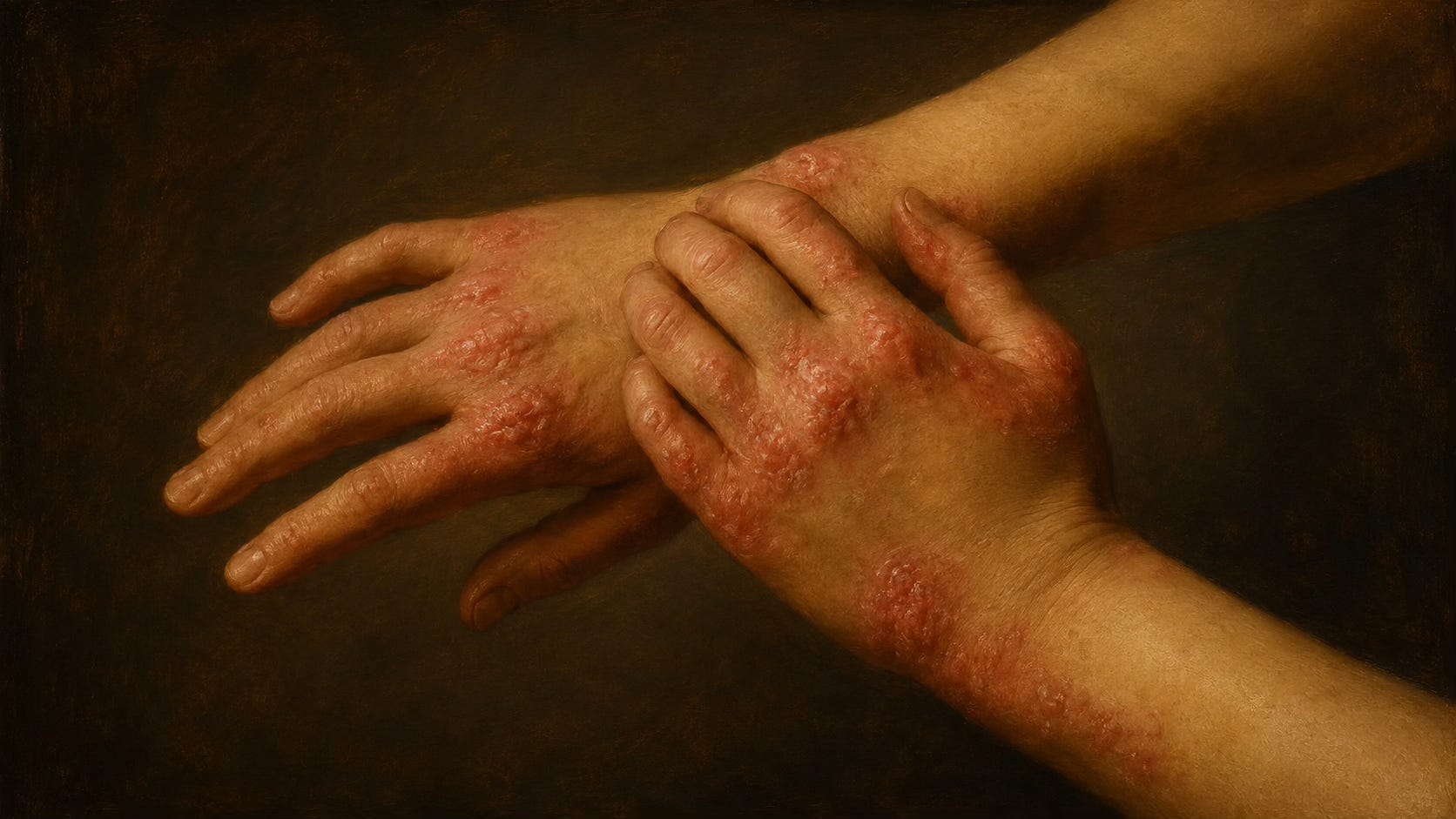
Most people with eczema spend years chasing creams, antihistamines, and steroid prescriptions, rotating through the conventional playbook without ever getting to the root of the problem.
Symptoms get suppressed for a while, then return. Sometimes worse. And the cycle continues.
That is not healing.
That’s just symptom management.
If you or someone you love deals with eczema, this article is going to offer you a different lens.
One that looks at what is actually happening in the body, why diet plays a larger role than most dermatologists ever discuss, and what a few simple natural interventions can do that no pharmaceutical company has financial interest in telling you about.
What Is Eczema?
Eczema or atopic dermatitis, as the medical establishment calls it, is a chronic skin condition characterized by red, inflamed, intensely itchy patches of skin.
It can appear on the arms, behind the knees, on the face, or scattered across the body.
For some people, it flares up occasionally. For others, it is a near-constant presence that affects sleep, confidence, and daily life.
The conventional explanation is that eczema is a combination of genetic predisposition and an overactive immune response.
Doctors often point to a compromised skin barrier, environmental triggers, and stress. This is mostly not the root cause.
But here is what gets left out of most clinical conversations: the role of what you eat, and what those foods are actually feeding inside your body.
The Role of Diet in Eczema
Modern diets are quietly waging war on your skin.
Here is why:
Seed oils (canola, soybean, sunflower, corn oil) are loaded with omega-6 fatty acids that drive systemic inflammation throughout the body — including the skin.
Refined sugar and processed foods spike blood glucose rapidly and repeatedly, weakening the immune system over time.
Mineral deficiencies — a direct consequence of nutrient-poor, ultra-processed diets, leave the immune system without the raw materials it needs to function properly.
Pasteurized dairy and certain nuts and vegetables can act as individual triggers in people who are already compromised.
The food industry will never tell you this.
The prescription model has no incentive to ask what is on your plate.
But the connection between diet and chronic skin inflammation is not speculative, it is something thousands of people have discovered simply by paying attention to what they eat and what happens afterward.
The Unconventional Reason Behind Eczema Flare-Ups
Here is where we move beyond what the conventional playbook offers.
The skin is not just a surface, it is a living ecosystem, home to bacteria, fungi, and microscopic organisms that coexist in a careful balance.
In a healthy body, this balance holds.
But when the skin barrier becomes compromised, weakened by inflammation, poor nutrition, or a stressed immune system, this balance breaks down.
Certain pathogens and microorganisms, given the right conditions (namely, an inflamed gut, a sugar-rich bloodstream, and a depleted immune system), begin to proliferate.
The immune system detects this overgrowth and responds the only way it knows how: with inflammation.
Histamine is released.
White blood cells mobilize.
The skin flares up.
What most people call an “eczema flare” is, in large part, the body’s immune system trying to fight off something it perceives as a threat.
Here is what comes next:
The good news is that managing eczema naturally is not complicated, and it does not require a prescription.
People have been using these remedies for generations, long before the pharmaceutical industry had a pill for every symptom.
What follows is clear, practical, and easy to act on.
In the next section:
The dietary foundation that starves pathogenic overgrowth
Three natural remedies, what they are, why they work, and exactly how to use them
Where to start if you are doing this for the first time
If you are ready to stop managing symptoms and start addressing the cause, keep reading…